Lisa RomereinYoud love to drop some pounds, but its tough to find time to breathe during the holidays, never mind prepare calorie-conscious meals. Thats why weve created a 1,500-calorie-a-day plan that lets you shed 10 pounds in five weeks, eating packaged meals, salad bar offerings—and even fast food.
Our grab-and-go diet is based on research showing that eating convenience foods can actually help you lose weight. The benefit: Built-in calorie and portion control. "Most people are not that good at judging what constitutes a portion," says LeaAnn Carson, RD, MS. "With frozen entrees, the choice of how much to eat is already made for you." Thats probably why in an eight-week study that Carson coauthored at the University of Illinois, women who ate two frozen entrees daily lost four pounds more—a total of 12.3 pounds—than women who cooked their own meals. Download your plan: A weeks worth of convenient meals (PDF) Next Page: Get fit quick [ pagebreak ]
tk
Lisa RomereinGet fit quick
To lose up to two pounds a week, follow our easy eating plan, plus do a cardio workout five days a week. Take these quick ideas from fitness expert Geralyn Coopersmith, a trainer in Healths Expert Network and a senior national manager of the Equinox Fitness Training Institute.
• Use your iPod to download a fresh cardio routine in an instant from a Web site like PodFitness.com; choose an intense workout to maximize your calorie burn.
• Sneak three 10-minute walks into your day—and be sure to make em vigorous—on your way to the deli for lunch, for instance, or to the post office.
For an easy way to add in a strength workout to get toned, keep a resistance band handy in a drawer at home or work. When you have a few minutes, twice a week, do 12 to 15 reps of each of these moves:
1. Stand with both feet on the band; grasp the handles, and curl your biceps.
2. Stretch band taut between hands, hold it above your head, and pull it down behind your head to do lat pull-downs.
3. Add some other easy-to-do muscle moves without the band, like crunches and lunges, to work your abs and legs.
How to suss out portions
• Dressings: Make an "OK" sign with your thumb and finger; thats 1 tablespoon.
• Nuts, dried fruit, and cheese: 4 to 5 playing dice equals about 1 1/2 ounces.
• Meats, chicken, and fish: Your palm, without fingers, is about 4 ounces.
• Potatoes, pasta, and rice: A serving the size of half a baseball is 1/2 cup.
Whether you're moving into a new space or going through a renovation, you're going to need to figure out where all of your furniture is going to go—and one of the most important steps in arranging your furniture is figuring out the correct placement of any area rugs you plan on putting down. Let's be honest: finding the perfect rug for your space can be quite the challenge, both in style (it's the base for your whole room, so you need to find one you really love!) and in size, no matter how many times you measure.
The good news? Knowing where it will live in your space and how you plan to arrange your furniture on top of it will help you get the size right every time. To help guide you, Cyrus Loloi, principal at Loloi Rugs, shared some of his best tips for placing a rug with House Beautiful.
In the dining room
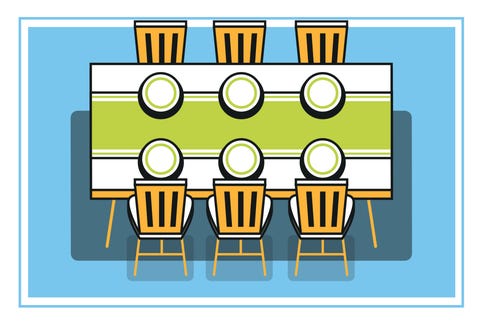
Placing a rug in the dining room is essentially all about the experience of sitting at the dining table. You'll want to center the rug under your dining table, and then make sure it's big enough to accommodate all of the chairs. "The key is to make sure the chairs still sit comfortably on the rug when pulled out and away from the table for someone to sit in them," Loloi says. "You don't want chairs half on, half off a rug when it's pulled out."
If you're not sure what size to buy, pull out the chairs around your table, then measure the space so you know your rug will fit perfectly underneath.
In the living room
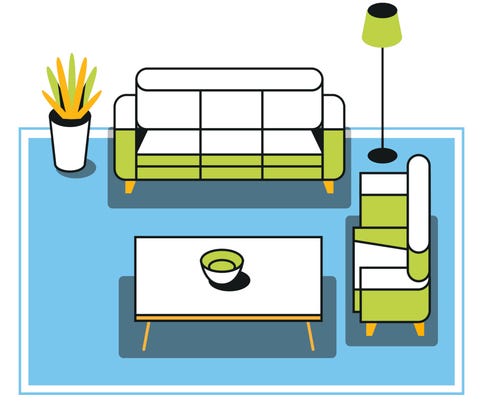
In the living room, placing a rug gets a little trickier, but it still all depends on the size of your space and your plans for laying out your furniture. According to Loloi, you have three main options for living rooms of various sizes:
For smaller living rooms, you have two options: You can go with a smaller rug (like a 5' by 8') that can float in the room in between the furniture, but under the coffee table says Loloi ("A rug that sits six to 12 inches in front of the sofa will anchor your space nicely, and still allows for walking room around the furniture.") or if you're trying to make your space feel bigger, you'll actually want a bigger rug that fits all furniture (like in the larger room section below) to unify the space.
For mid-sized rooms, go with a larger rug (like an 8' by 10') and place your large, anchor furniture (i.e. the sofa) around so that only the front legs are on top of it. Loloi notes that you'll want the rug to extend beyond the sides of the sofa, too.
For larger rooms, Loloi suggests getting a bigger rug (like a 9' by 13') and using it to frame your space. Then, place all of the furniture completely on the rug. "Just be sure there is still room around the outside of the rug for walking, so you aren't partially on and off the rug," Loloi says. Alternately, if you're trying to divide the room up into different spaces (like various seating arrangements, or an open concept with dining and seating areas), use different rugs to define each of these spaces.
Even if the suggested rug sizes above don't quite work with the dimensions of your home, you can still follow the same principles of placement and buy a rug based on the dimensions of your living room and your furniture.
In the bedroom
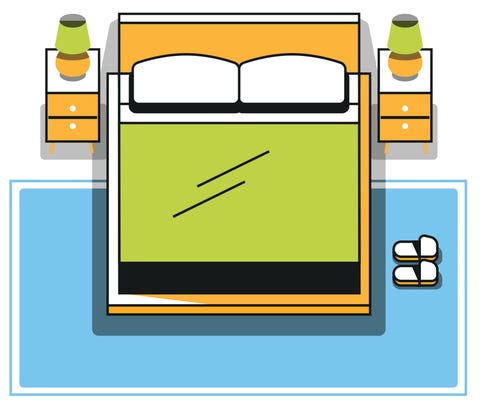
When it comes to the bedroom, sizing really depends on the size of your bed. Loloi explains that the ideal size for a queen bed is an 8' by 10', while a king would look better with a 9' by 12' rug (and that same size works for two twin beds in a kids' room). For a full, a 5' x 8' rug should suffice.
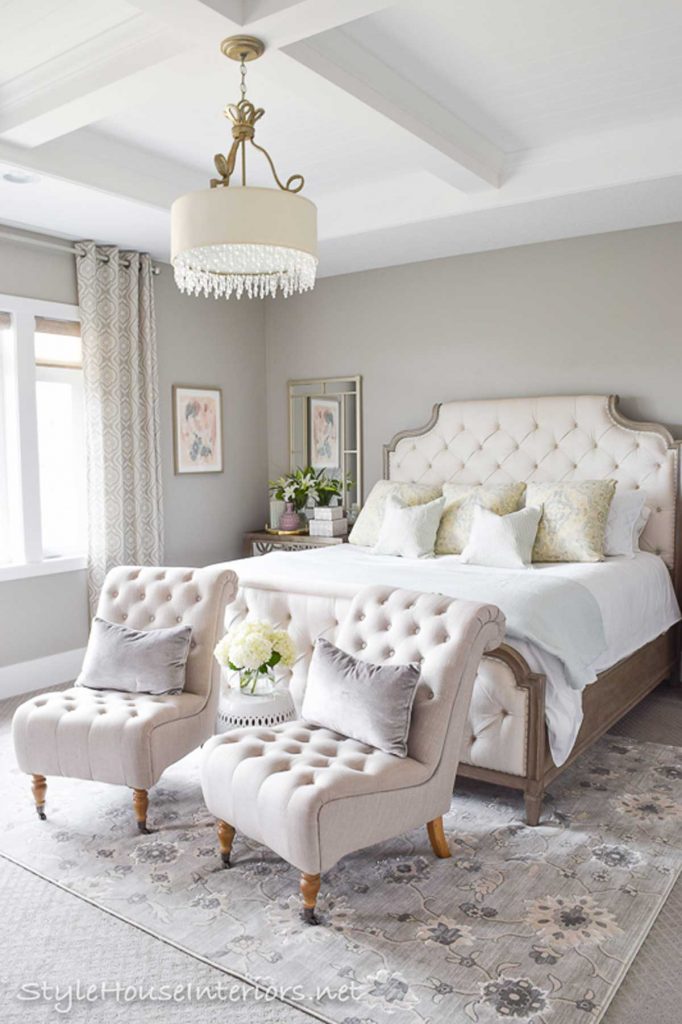
In terms of placing the rug, you have a lot of options, but the most preferred way is to place the rug partially under the bed. In this case, you'll want to lay the rug perpendicular to the bed and pull it under, stopping a few inches before your nightstands so it's around halfway under the bed, with the bed centered on top. "This maximizes the amount of useable rug space, and gives you a soft surface to step onto when getting out of bed," Loloi says. In a smaller room, you can also try just placing a rug in the middle of the room, or at the foot of the bed to add interest and help pull decor together, Loloi adds.
If you don't want to place a full area rug under the bed or in the bedroom at all, Annie Selke, founder and CEO of her eponymous rug and decor brand, has an easy hack: Just place runners on either side of the bed. You'll still have that soft, comfy experience when you step out onto the floor in the morning, no matter what size the room (or bed) is.
One thing to keep in mind no matter what room you're putting a rug in? "Remember that rugs can create an optical illusion, so make this work in your favor," Loloi says. "Too small of a rug can make any space look disconnected. When in doubt, go for the bigger rug—it will unify the furniture and make the room look bigger than it is."
Follow House Beautiful on Instagram.
Brittney MorganMarket Editor, House BeautifulBrittney Morgan is a noted land mermaid and a Virgo with a penchant for crafts, red lipstick, and buying way too many throw pillows.
This content is created and maintained by a third party, and imported onto this page to help users provide their email addresses. You may be able to find more information about this and similar content at piano.io
The living room is one of the most important areas in your house for a great hosting experience. It's likely you and your guests will spend countless hours in this room, discussing and entertaining.
Decorating your living room properly will deliver deeply satisfying living for your leisure time. To get there, however, you must pay attention to all of the following areas:
1. the colors that you select
2. material and quality of seats and furniture
3. wall decorations and art
4. lighting and light fixtures
Below we show you some great ideas for decorating your living room.
The Best Colors for Your Living Room
One area that will have a disproportionate impact on the mood of your living room is the color you choose for the walls. While you can install wallpaper to change the look of certain walls, there are areas that wallpaper cannot cover. Getting the wall color right, therefore, gives you the best shot at creating a remarkable effect.
Some of the best color palettes for living rooms include:
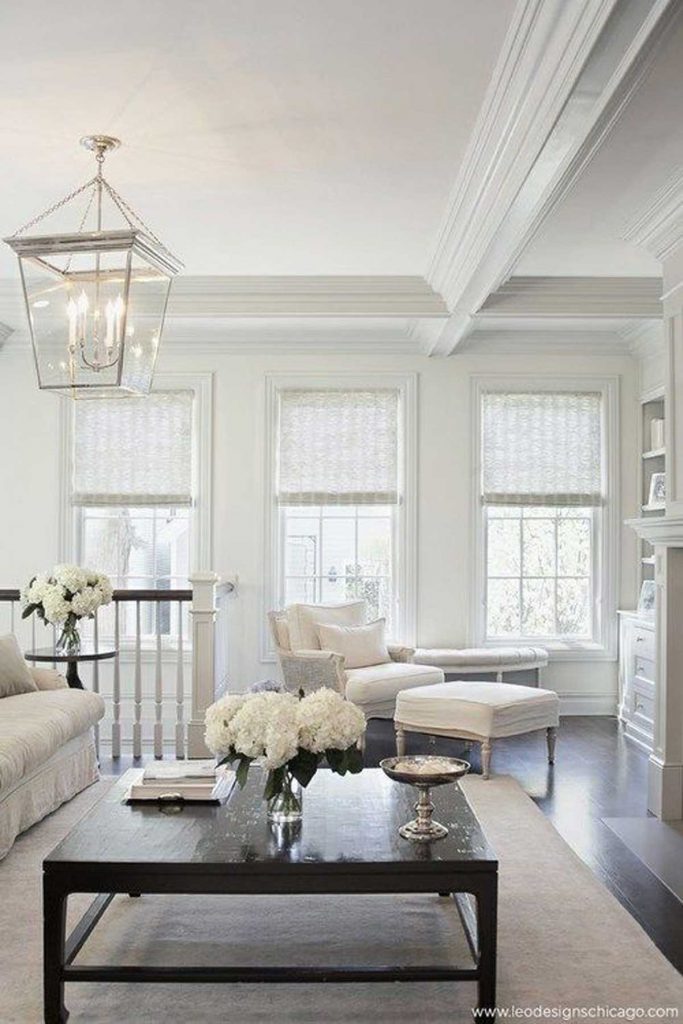
1. White - White walls add a touch of class. They are the perfect backdrop for decorating with upscale furniture.
2. Turquoise - This color is great for creating an informal but refined feel. Your kids and family will love the refreshing mood this color creates.
3. Cream - Striking a balance between formal and informal, cream-colored walls create a quiet, soothing effect.
Furniture Choices
With your wall color selection made, you should select furniture that pairs well with the colors you've already chosen. For example, combining white couches with white walls will create resonance in your room design.
Make sure to provide ample seating to avoid crowding. Add multiple sofas, easy chairs and other seats that can accommodate a complete roomful of people, depending on the size of the room.
Furniture like TV stands and tables should generally blend in with the colors of the room and ceiling. There are some natural materials, however, that can work regardless of the colors on the walls. For example, wooden table surfaces look good whether your walls are white, blue or another color.
Lighting Ideas
You can greatly improve the aesthetics of a living room with bright lighting and impressive light fixtures.
To start, you can consider a beautiful chandelier in the center to provide light around the whole room. This central masterpiece ensures adequate lighting throughout the living room while adding an air of elegance.
You can then add to the light sources in the living room with individual lights on tables and around the walls in areas where people will not knock them down.
Carpeting
Consider adding carpeting to your living room to create a comfortable walking area. Carpeting lets you and your guests go barefoot if you choose. The living room almost demands this since you will want to take off your shoes and kick back on occasion. Warm plush carpets provide a good, comfortable surface for this. There are many choices when it comes to carpet size.
If your living room is very large, you can opt for wall-to-wall carpeting. On the other hand, if it's smaller, you can add just an area rug in the place where you will sit. For example, you can have a rug around the sitting and TV area where your kids will play.
The advantage of area rugs over wall to wall carpeting is, mainly, lower costs and ease of replacement. You can completely change the area rug and create a new aesthetic in a fraction of the time it would take to begin installing new wall-to-wall carpeting.
Art Ideas for Your Living Room
Many homeowners like to have some wall art in their living room. If your living room is spacious, it can accommodate a good-sized piece of art mounted alongside one wall. In some instances, you can consider multiple art pieces. Invariably, tasteful art adds to the sophistication of a living room. It adds an interesting item that sparks many conversations from impressed guests.
Selecting art is an opportunity to express your unique personality. If you are fairly conservative, you can select some classical type pieces that portray a quiet life. If you are more adventurous, you can experiment with a post-modern impressionist piece that others might consider risky. It's your space, and so feel free to decorate it to express who you are.
With the cost of rent and the cost of living constantly on the rise, people are looking for more affordable housing options. This led to the tiny house movement that has swept the nation in recent years. The idea of downsizing to a couple hundred square feet might be daunting to some people, but there are a number of advantages. Learn the benefits of living in a tiny house and see if it's the right fit for you.
Tiny Houses Are Cheaper Than Traditional Houses
The average price of a new home sold in the United States as of October 2018 is $395,000, according to the U.S. Census Bureau. While houses are available for much cheaper, you can still expect to spend hundreds of thousands of dollars on the purchase of a home. The average rent in the U.S. is $1,405 per month or $16,860 per year, notes CBS News. In contrast, you can find tiny homes for sale for less than $19,000 up to $50,000. If you rent a house or apartment, a tiny house will pay for itself in just a few years. If you are considering buying a house, opting for a tiny home will save you hundreds of thousands of dollars.
You Can Take It With You
Many tiny houses are built on a trailer, in an RV or are small enough to load on a flatbed truck to take on the road. You can travel the countryside and save money on hotel and lodging expenses by taking your tiny home with you. If you move for a job, there's no need to spend time looking for a new home in a new city — just take the tiny house with you.
They Are Energy Efficient
People who build tiny houses for off-grid living often equip them with solar panels. This eliminates the need for a power bill, thus lowering your expenses even more. However, even if your tiny house is hooked up to electric power, it still uses less energy for heating, cooling, appliances and more. Tiny houses often have a square footage ranging from 100 square feet to 400 square feet. That's a huge difference from trying to power a 2,600-square-foot home.
Your Life Has Less Clutter
People spend a lot of their adult lives trying to deal with clutter. They look up tips for organizing closets, pantries, playrooms and virtually every room of the house. When you have a lot of space, it's natural to want to fill that space with things. You don't have that option when you live in a tiny house. You have to make hard decisions about what to keep and what to get rid of. Additionally, you won't be making frivolous purchases because you know there's nowhere to put it when you get home — more money saved.
Cleaning Takes Less Time
With just a few hundred square feet of space, there's not a lot to clean. Additionally, there are less things to dust and wash. If you have a busy schedule and usually rely on having a housekeeper come in to help, you can eliminate that expense. You can have your entire tiny house clean in a matter of minutes.
More Independence for Family
Some groups of people, such as aging parents, adults with special needs, students and others, rely on family for assistance with care and housing. Having their own home may be prohibitively expensive or the person may not be equipped for that level of independence. Rather than living in a larger home, having a tiny home parked in the backyard allows them to have a greater sense of independence while still under the care of family. Tiny senior citizen homes for sale have become increasingly popular in recent years and are lovingly referred to as "granny pods."
Sometimes you just have to defy conventions. These modern house plans do just that. Not only do their exteriors look different, but there is a science to it. Homes built this way often have the living space on the top floor and the bedrooms on the bottom floor. The added elevation allows homeowners to enjoy views from up high. Many of these homes are perfect for a lakefront, beachfront, mountain, or coastal area. Take a look at these three unique and inviting house plans to get an idea their appeal.
This house plan's modern exterior is sure to catch the eyes of passersby. Just wait till they walk in, they won't want to leave.
This angled and contemporary house plan is a popular design. Because of its layout this house plan is classified as an inverted two-story. With the bedrooms on the ground floor and the living space on the top floor this house plan is ideal for lots with lots of scenic views. This house plan also includes a quiet study that will tempt you to work from home and a roof terrace perfect for stylish parties. This house plan also has a very low footprint at on 2,562 square feet.
This modern house plan is sure to give you a great view.
If you have some great views to capture then take a look at this modern house plan. An exclusive design, this house plan is often referred to as an "upside down" plan. No this plan doesn""""t defy gravity, but it does have a second floor living area where you can take advantage of picturesque views. The upper level also features a large deck for you to enjoy some outdoor living. The lower level contains four bedrooms, including a spacious master suite with two full baths.
Given that it is perfect for a lot with a view, it should be no surprise that this house plan is designed on a pier foundation in order to accommodate beachfront or lakefront locations, but if your lot allows this house plan can also be built with a basement.
Another house plan with a view. This modern house plan is perfect for a lakeside, coastal, or mountain view lot.
Homes like this one mix exterior materials while accommodating a view and providing open space inside. The house also sports a narrow footprint to fit many mountainside, lakefront, beachfront, or coastal lots. The wrap-around balcony also captures the views as well as the breezes. The master bedroom is situated on the main level with its own private balcony. A master bathroom also has a walk-in shower. The third floor remains open to serve as flexible space. It can be a game room or a sleepover headquarters. The lower floor also contains flexible space for family functions and a suite of its own.
Homes like these here are not just unique and fun to look at, but they capture beautiful views. Their layout might be a little bit counterintuitive but "upside down" plans mean that there will be plenty of picturesque views to see from windows and decks. If a modern house plan is catching your interest, see more plans like these in Direct from the Designers"""" modern house plan collection.
The Luxe style speaks to us of precious metals, reflective surfaces, exotic timber, velvet and silk. It spells elegance. You're individual and imaginative, and attention to detail is key, with daring colour palettes, extreme scale, sexy and lavish fabrics creating an intriguing and sumptuous space. Luxe interior design pulls from the sophistication and refinement of the Hollywood regency era. It draws design elements from around the globe and has brought ornamentation back into homes in a modern way.
1. Top tip for Luxe style
Our top tip to creating the perfect Luxe style is to embrace the mirror (it reflects light and adds depth to a room) and ensure the trim is a lustrous metallic to give sophistication and presence.
2. Traits
There are many common traits that complement the Luxe style including guild, mirror, glass, velvet, buttoning, rose tint, marble, gold, crystal, colour glass, wallpaper, perspex, fur, animal print, granite, chandeliers, vintage, high gloss, wallpaper, metallic.
Most of the above traits can be used as focal points in a room. For instance, an oversized piece of art can give your space a 'wow' factor.
3. Designers/Artists
Luxe fans love these household names: David Hicks, Greg Natale, Kelly Wearstler, Suzanne Kasler, Luis La Pegna, Philippe Starck, Tom Ford.
Luxe style is all about the finer details in life. With its elegance and extravagant finishings, Luxe can make your home feel and look like a million bucks!
Rose is a full-time freelance writer who frequently writes about education, special education, DIY projects, food, Milwaukee, and more.
How to Decorate a Small Living Room
Every small living space offers design challenges. While it's important to make all of the rooms in your home functional, the living room is especially key because many people spend a lot of their time at home in the living room. From selecting furniture that is an appropriate scale for the space to maximizing hidden storage solutions to strategically placing a mirror to add depth and light, there are an extensive range of practical and easily attainable design ideas that will help you create the living room of your dreams in your small space.
6 Small Living Room Ideas
1. Select Furniture to Fit the Existing Space
2. Consider Hidden Storage
3. Create a Focal Point
4. Add Light and Depth
5. Don't Be Afraid of Color
6. Take Advantage of Vertical Space
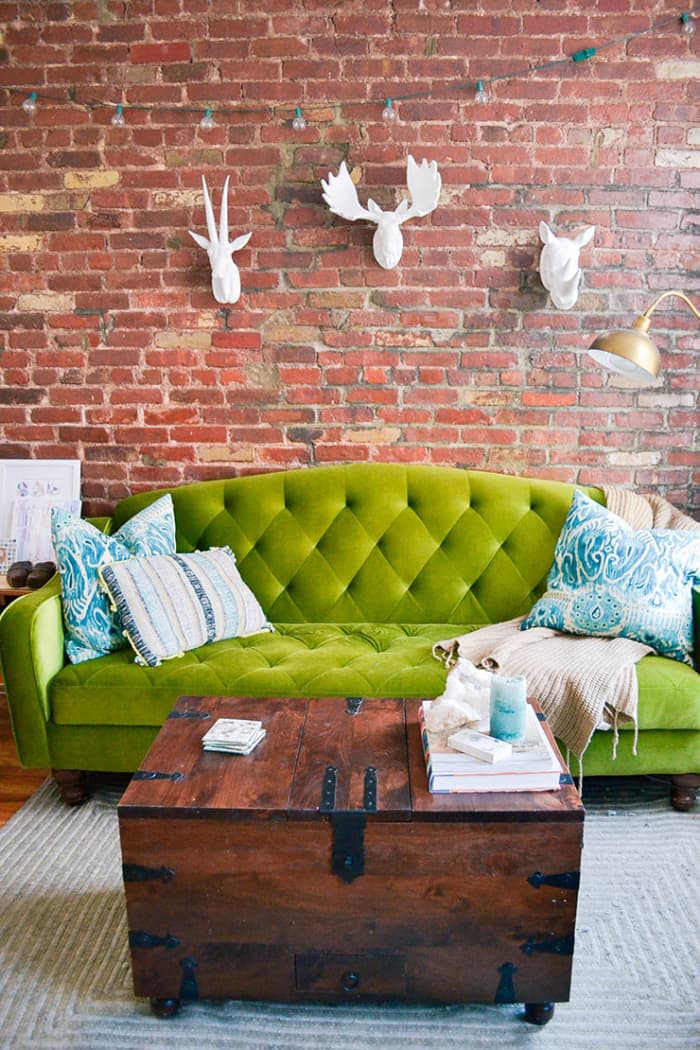
The trunk serves as a coffee table and storage piece while adding a funky vintage touch to the living room.
Amanda Holstein via Advice From a Twenty Something
1. Select Furniture to Fit the Existing Space
Determine Scale and Configuration
When you're working with a compact living room, large-scale furniture often isn't an option. Be realistic about the space. For example, if an oversized recliner won't fit, choose a pair of smaller chairs. Many people also get hung up on common furniture configurations. For example, nothing says that you need a full-sized sofa in your living room. A love seat paired with a bench and an armchair may work more naturally in your space.
Think Multifunctional
Choosing multifunctional pieces will also make the most of your living room. For example, a bench with storage will provide seating while housing pillows and blankets. A coffee table or console table makes a great addition to a living room but only when it makes sense for the space. Your small living room may be better suited for two small tables that open up the space and can be moved as needed to accommodate different functions.
Consider Floating Furniture and Low Seating
Floating furniture and low seating can make all the difference when it comes to keeping the space open and flowing. Design a floating furniture arrangement in the center of the room instead of pushing pieces up against the walls. Install shelves and other built-in components off the floor to create the illusion of space. If you choose low seating, select pieces that don't distract from the focal statement in the room. For example, a pair of low stools in front of the mantel will keep the fireplace as the focus of the living room.
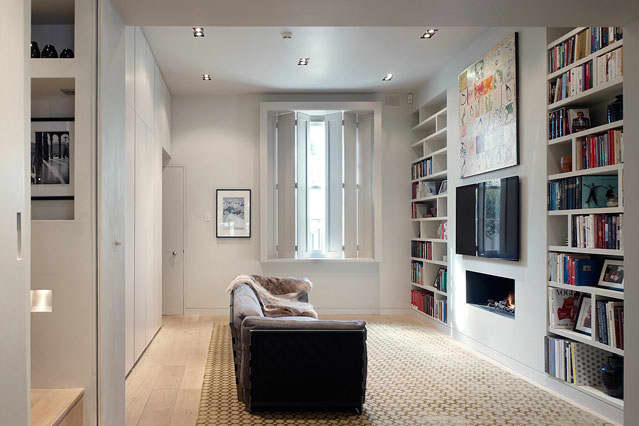
The wall length built-in keeps this narrow living room streamlined and clutter free.
Tory Kingdon via House and Garden UK
Concealed storage is a great way to house items in the living room without creating a cluttered space. Furniture pieces that boast concealed storage, such as an ottoman with built-in storage, are a great option. You may also want to consider decor pieces that do double duty as storage, such as colorful baskets or jars. Do you have a hard time finding concealed storage pieces that don't take up a ton of floor space? Think about biting the bullet and devoting a single wall to built-in storage. To further streamline the storage, keep your items in the built-in hidden behind doors or curtains.
Read More From Dengarden
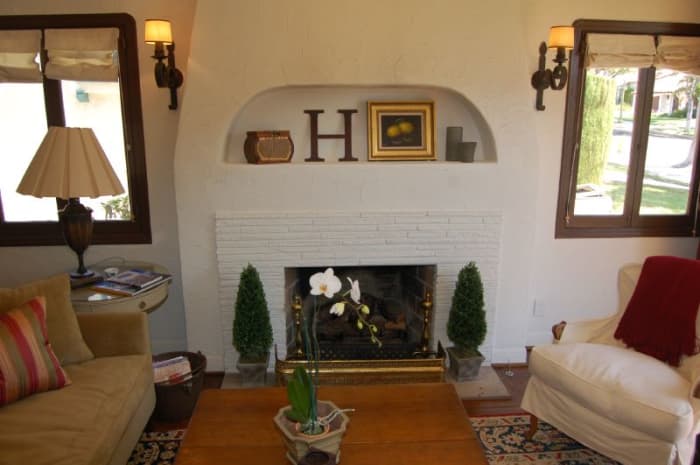
The living room layout showcases the focal fireplace and mantel.
Kendyl Young, CC BY 2.0, via Flickr.com
3. Create a Focal Point
A focal point is ideal for drawing people into a space while making it more uplifting and even sophisticated. Think about focusing your living room around a fireplace, sofa, coffee table, artwork, or mirror. Once you've settled on your focal point, design the rest of the living room around your statement piece to pull the entire look together.
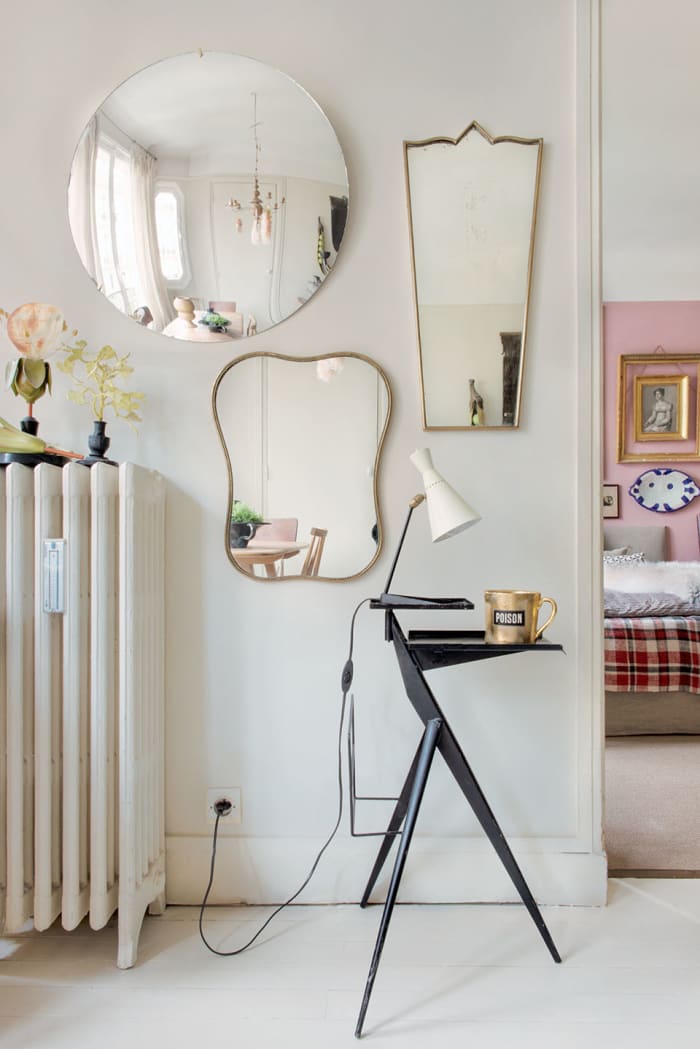
The mirrors reflect the whole space, making it appear larger, while bringing more natural light into the room.
Brunet Souet via Milk Decoration
4. Add Light and Depth
Small living rooms with flat features and dark corners look dreary, even when they boast unique furniture and wall hangings. Maximize the natural light in the room, and don't be afraid to add artificial light sources as well. You'll bring even more light and depth into your compact living room with wallpaper and strategically placed mirrors and plants. Purely decorative mirrors still pack a visual punch and draw extra light into the space.
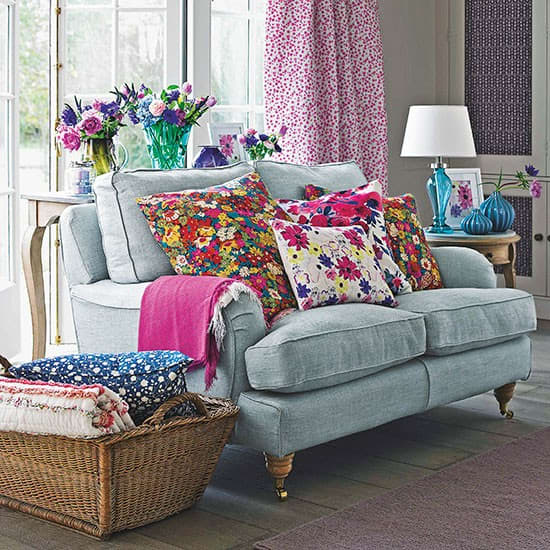
The floral theme ties the colored items in the room together.
House to Home UK - link no longer active
5. Don't Be Afraid of Color
Many people steer clear of color in small living rooms, believing that it will overwhelm the space. While there is nothing wrong with designing a small living room that features neutral shades, color can make the space appear larger. Select a color scheme with a maximum of three shades to create a unified aesthetic. If you want to use additional colors, incorporate them as accents. Typically lighter shades make a space look larger, but careful use of darker shades takes the style and drama in the room up a notch.
When you paint a small living room, select a satin or semigloss finish to reflect the light. If you want to tie the color scheme in the room together without painting or buying new furniture, consider an area rug. Layer a rug over carpeting to make the room feel cozier or conceal dark flooring with a brightly colored rug to lighten up a dark space.
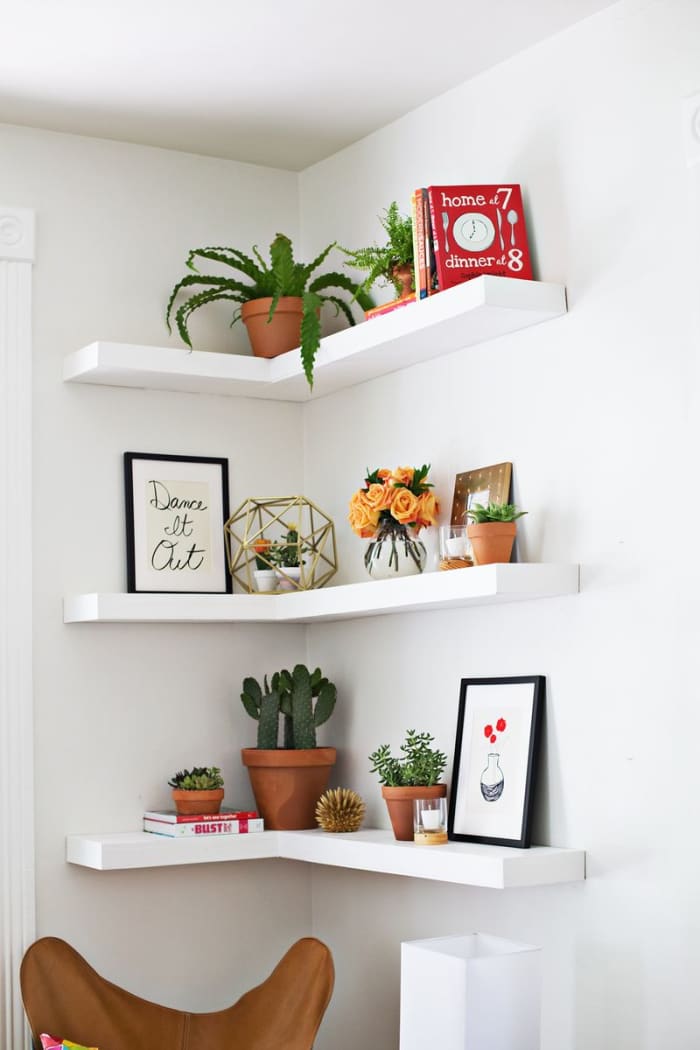
This set of floating shelves draw the eye up while adding room for knick knacks in otherwise wasted corner space.
Sarah and Joshua Rhodes via A Beautiful Mess
6. Take Advantage of Vertical Space
Build up instead of out to maximize the available space. When you hang curtains, place the curtain rods right below the ceiling. Then choose curtains that extend all the way to the floor to make the ceiling look higher. If you're selecting art or other wall hangings, consider designing a gallery wall or choosing a few large pieces that fill the whole space. Do you have an odd nook that currently serves little or no purpose in the living room? Think about constructing shelves to simultaneously add storage and draw the eye upward.
Small Family Room Design
Finally, creating the ideal flow for your small living room is an ongoing process. It often takes weeks, or even months, of living with a living room arrangement to determine what is and isn't working. Don't be afraid to keep making tweaks and adjusting the layout until you find a arrangement that suits you and your family.
Additional Small Home Resources
Frugal Storage Ideas for Small Homes: Creative, Unique Organization Methods Creating functional storage for a small home is simple when you're equipped with the right organizational tools. Pick up purchasing resources, general organization tips, and much more.
How to Make the Most of a Small Kitchen: Simple, Affordable Kitchen Solutions for Every Budget Organize and brighten up your small kitchen space with practical solutions to create a functional yet inviting space for family and friends.
Very good article you wrote very helpful tips and pictures are so beautiful you added.
Chitrangada Sharan from New Delhi, India on April 05, 2016:
Excellent hub!
I enjoyed going through your tips and suggestions to design and lay out a small living room. Using the place below staircase is a very nice idea. Very attractive pictures to complement your interesting and useful hub.